
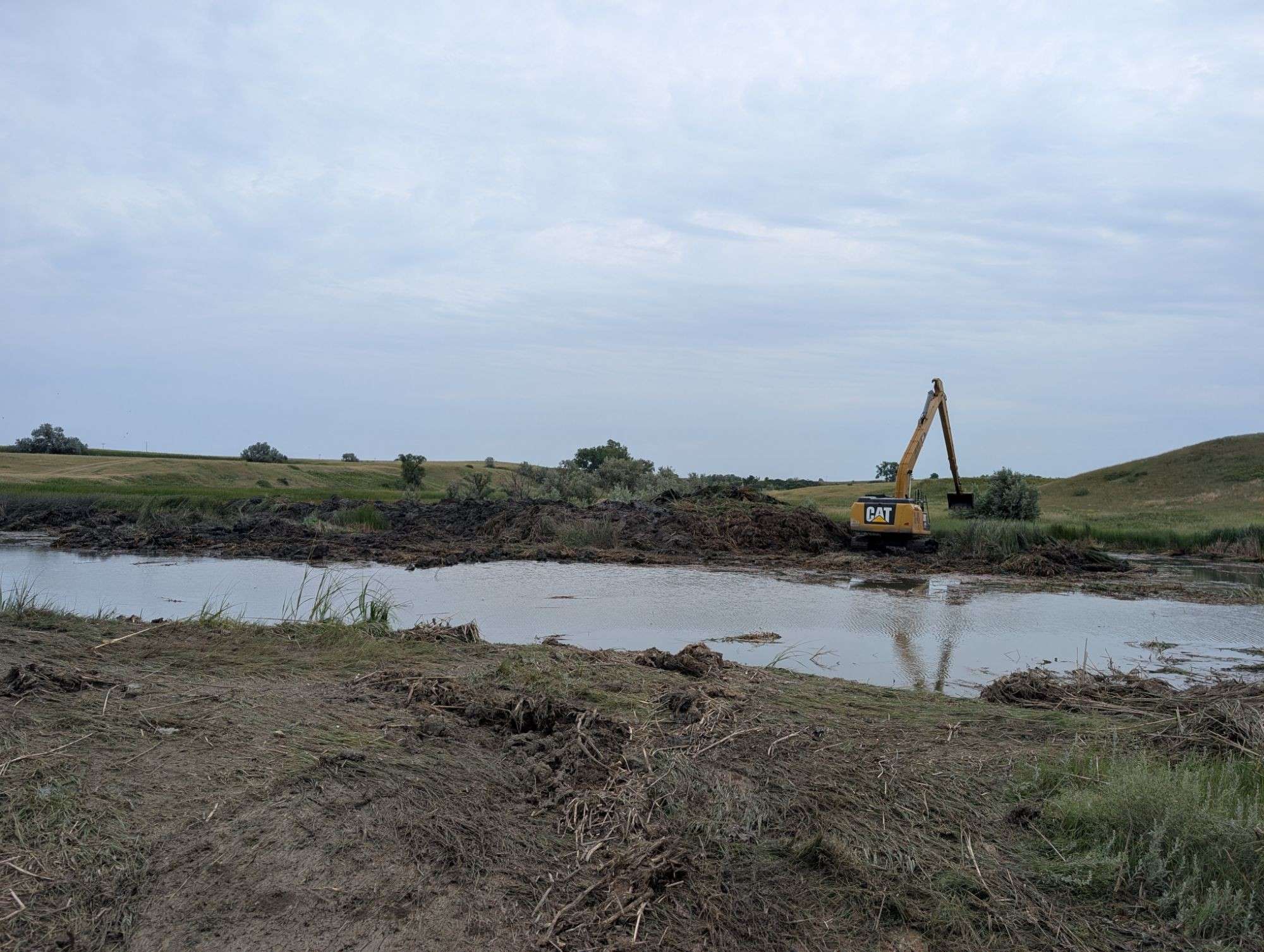
A pond that won’t hold water is one of the most common problems we see on ranches across Western South Dakota and Northeast Wyoming. Sometimes it’s a slow seep that drops the pond a little faster every summer. Sometimes it’s a dam that leaks at the toe every time the pond fills. The fix depends on where the water is going, so that’s where to start.
Is it leaking, or just evaporating?
Western South Dakota summers are hot, dry and windy, and a shallow pond can lose a lot of water to evaporation alone. Signs that it’s actually leaking:
- It drops much faster than neighboring ponds in the same weather.
- It keeps dropping on cool, calm, cloudy days.
- There are wet spots, seeps, cattails or flowing water on the downstream side of the dam or at its toe.
- The water level stops falling at the same height every year, which can point to a leak at that level.
A simple check: set a bucket of pond water on the bank at the waterline and mark both levels. After a few days, the bucket shows evaporation. If the pond dropped a lot more, the difference is seepage.
Why ponds leak
- Not enough clay. Ponds hold water where the bottom and banks have enough clay. Sand, gravel and fractured rock let it soak away.
- A dam that wasn’t compacted. Fill pushed up loose, without being packed in thin layers, lets water work through.
- No core or cutoff. Without a compacted clay core trench under the middle of the dam, water can run underneath it.
- Roots and burrows opening paths through the dam.
- A spillway or outlet letting water around or under the dam.
- Cleaning out too deep. Digging a pond deeper than it was built can cut through the clay layer into gravel underneath.
The fixes that work
Rebuilding part of the dam. For a leak through the dam, the usual fix is to dig out the problem section down to good material and rebuild it with clay, compacted in thin layers. A dam that never had a core may need one added.
Sealing the pond bottom. For seepage through the bottom, NRCS recognizes three main approaches:
- Compacted clay: a layer of clay soil hauled in and compacted over the pond bottom and sides.
- Bentonite: sodium bentonite mixed into the existing soil and compacted, so it swells when wet and plugs the gaps.
- Liners: synthetic membranes or geosynthetic clay liners, laid over a prepared bottom and covered.
All three generally need the pond drained or dry, and all depend on getting the right material in the right place and compacting it properly. On large or steep-sided ponds, how the layers go in on the slopes matters as much as what goes in.
Fixing the spillway or outlet. If water is getting around the end of the dam or under a pipe, that has to be fixed too, or the dam will keep losing water there. See why pond spillways wash out.
What to do now
- Watch it for a few weeks and note how fast it drops and where any wet spots are.
- Keep stock off the dam if it’s soft or slumping.
- Get it looked at when the water is low. Late summer and fall show the most.
Black River Contracting repairs pond and stock dams across Western South Dakota and Northeast Wyoming, from rebuilding leaking sections in compacted lifts to cleaning out and reshaping old ponds with our long-reach excavator. See dam repair and cleanout, or request a quote.