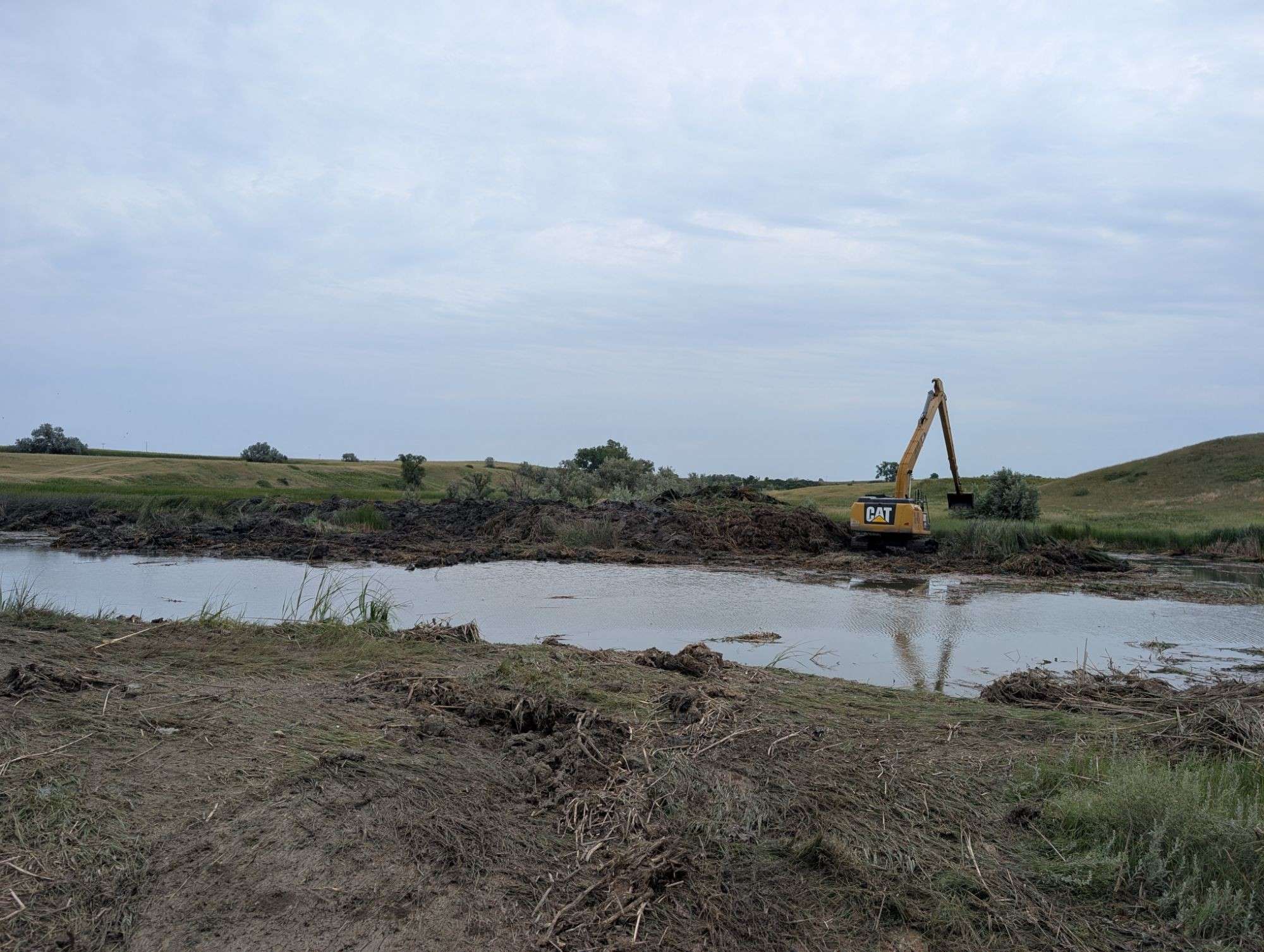
Stock ponds and dugouts fill in. Every runoff carries silt off the pasture, cattle wade the edges, and cattails close in from the banks. A pond that held water through August ten years ago goes dry in July, warms up, grows algae and turns into a mud hole cattle get stuck in.
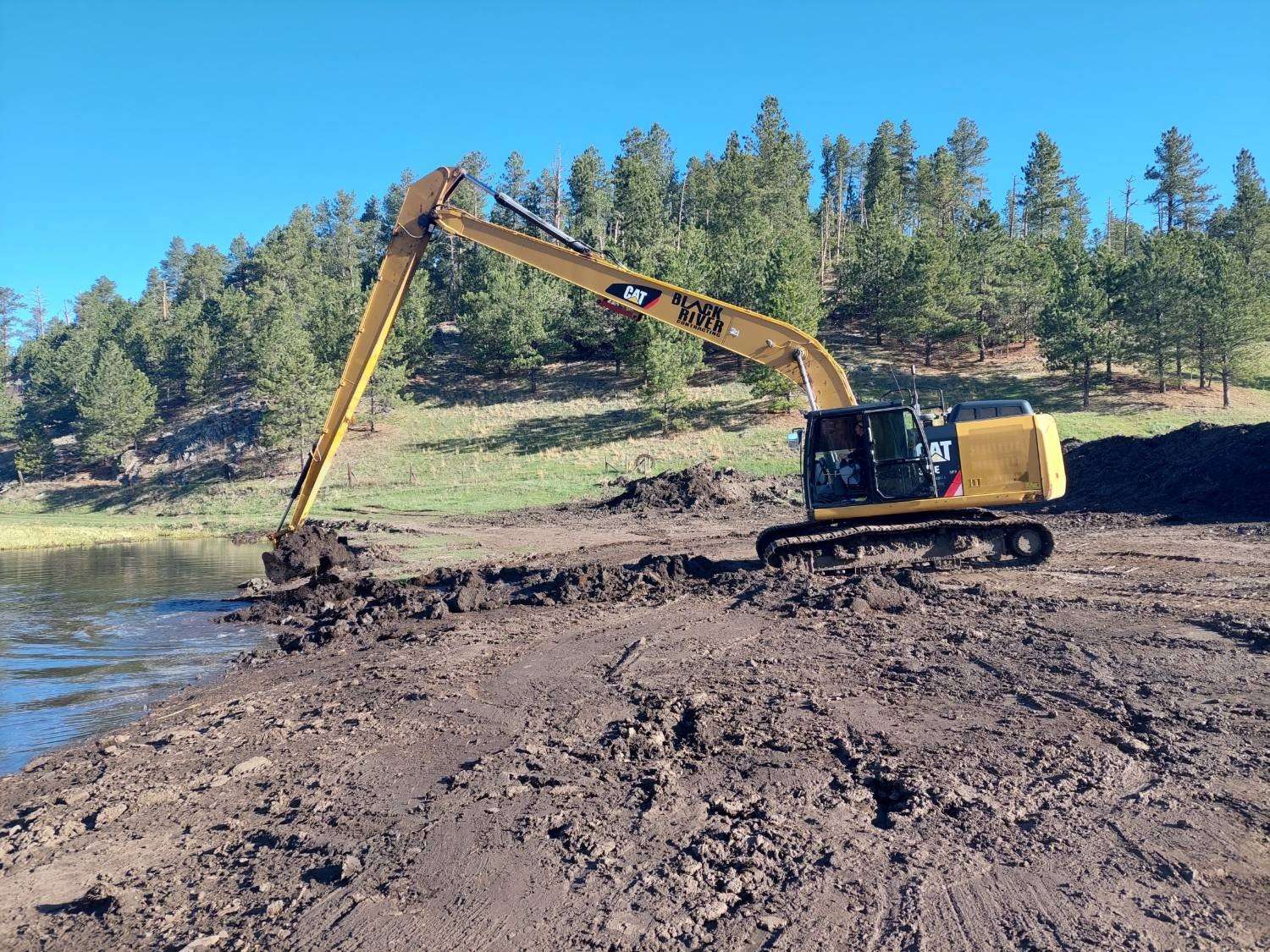
Cleaning it out restores the depth that keeps water through a dry summer and stays open longer in winter. We do it with a Cat 324E with a 60-foot long-reach front, working from the bank or the dam crest so the machine never has to drive onto the soft bottom.
Stock ponds and dugouts
- Stock ponds (stock dams) sit behind an earth dam across a draw. We clean the silt out of the basin, rebuild a dam crest that’s settled or been trampled, and clear the spillway so a big rain goes around the dam, not over it.
- Dugouts are dug into flat ground with no dam, catching runoff or groundwater. They fill in from the edges and the inlet. The long reach lets us dig the middle back down from the bank without tracking up the sides.
How a cleanout goes
- We look at it with you. We need to see the pond, the access in, where the machine can sit on firm ground, and where you want the spoil.
- We call in locates. Buried lines on ranches are rarer than in town but not unheard of, especially near water lines and power to a well.
- We dig from the bank. The machine works its way around the pond, pulling silt to the edge and loading or placing it as we go.
- We place the spoil. We spread it, build it into the dam or stockpile it to dry, whichever you choose.
- We shape the edges. A sloped edge lets cattle drink without wading in and breaking the bank down.
Where we work
Ranches across Western South Dakota, from the Black Hills foothills out to the prairie around Sturgis and Hot Springs, and in Northeast Wyoming around Sundance, Moorcroft, Newcastle and Gillette.
If the dam itself has washed out, seeps or needs a new spillway, see dam repair and cleanout. To build a new pond, see pond construction. For water lines, tanks and other ranch work, see farm and ranch improvements.